We already use Claude Code and Codex. Why would we need Orkindo?
The model is the same. What changes is where the agent lives, who starts the work, who can use it, and who answers for it. An honest comparison between using the models directly and running agents on a platform.
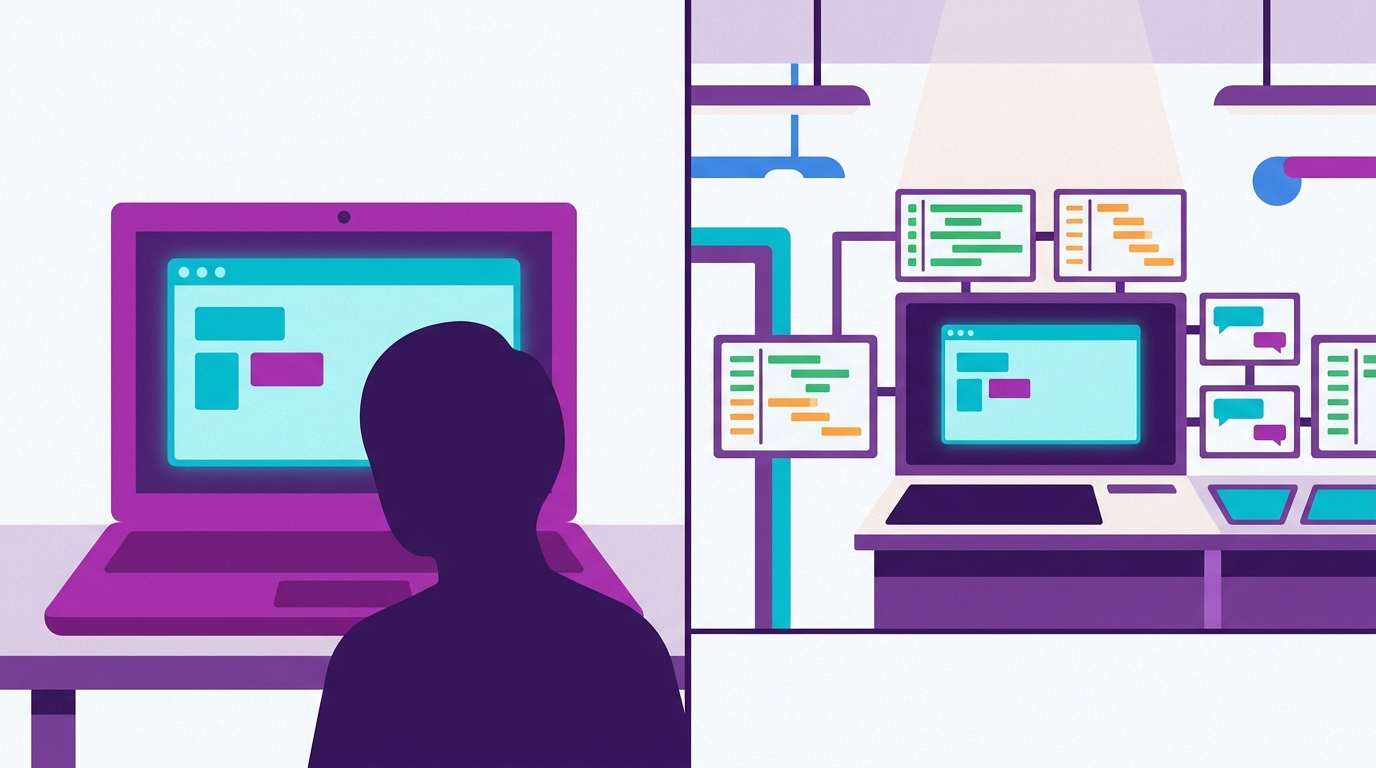
It is the question we hear most in meetings with technical teams: "Our developers already use Claude Code and Codex, and sales uses the ChatGPT or Claude app. Those are the same models Orkindo uses. What exactly do you do that we can't do ourselves?"
It is a great question, and the short answer is: the model is not the product. Claude Code, Codex, and the chat apps are excellent tools for one person to get more done. Orkindo is infrastructure for a company to put agents to work. Both use the same frontier models, but they solve different problems, and at most of the companies we work with they live side by side.
This post explains where that line sits.
Same model, different problem
When you open Claude Code in a terminal or start a conversation in the app, the setup is always the same: one person, one session, one goal. You write the request, the agent works with the permissions you have on your machine or in your account, you review the result, and you close the window. For writing code, chasing a bug, or drafting a document, that is exactly the right setup.
The trouble starts when a company tries to stretch that setup into something it was not built to be:
- a report that has to land in Slack every day at 7 a.m., whether or not someone remembers to ask;
- an agent that answers customers on WhatsApp by querying the orders database;
- a stock alert that fires when an event happens in the ERP;
- an assistant a field technician uses on a phone, without knowing what a terminal is.
None of these cases has a person sitting in front of a prompt. That is where the difference begins.
| Direct model (Claude Code, Codex, apps) | Orkindo | |
|---|---|---|
| Who starts it | A person, typing a prompt | A schedule, a webhook, an incoming message, or a person |
| Where it runs | On the user's laptop or account | On the company's dedicated instance, in our cloud or yours |
| Who uses it | Whoever has the tool, usually developers | Anyone, on WhatsApp, Slack, Teams, Google Chat, or an internal app |
| Data access | The person's own credentials, set up by them | Read-only credentials, connected once, granted by role |
| Audit | Local history or the individual account | A central audit log of every action and every session |
| Cost | An invoice per seat or per key | Tokens and cost per workflow, per model, and per agent |
| Quality | "Looked fine" to whoever asked | Eval suites run on every prompt or model change |
| Models | One vendor per tool | 100+ providers, including open-source models on your own infrastructure |
1. Who presses the button
The most fundamental difference is the trigger. An assistant tool waits for your request. An Orkindo workflow runs on its own: on a cron, when an external system calls a webhook, when a message arrives on WhatsApp, Telegram, or Google Chat.
That sounds like a detail until you see it in practice. The production summary that "so-and-so generates in Claude every morning" stops existing the day so-and-so goes on vacation. The same summary, as a scheduled workflow, lands in managers' chats every day, leaves a trace of every run, and tells you when it fails.
The work that actually frees up operations hours is rarely what someone remembers to ask for. It is what happens behind the scenes, every time, without anyone asking.
2. Where the agent lives
With Claude Code or Codex, the agent lives where the session lives: on the developer's laptop, in a container they spun up, or in their account on the vendor's cloud service. Secrets, database connections, and context end up scattered across every machine.
On Orkindo, every customer runs on an isolated instance: its own domain, PostgreSQL, Redis, containers, and network. It can run in our cloud, be self-hosted, or sit in your data center, reaching private databases behind your firewall without opening a port. The agent does not depend on anyone's computer being on, and data never passes through anyone's personal machine.
3. Who can use it
Claude Code and Codex are developer tools. The chat apps are individual tools. Neither was built for your customer to talk to an agent on WhatsApp, or for a clinic's front desk to use a form with the company's branding.
On Orkindo, the same agent answers across channels (WhatsApp Business, Telegram, Slack, Teams, Google Chat, email, the chat bubble on your website, your own API), and any workflow can get its own screen: a form, a dashboard, a step-by-step wizard. When a conversation needs a person, it moves to a shared inbox, a human agent picks it up with the full history, and hands it back to the AI when done.
You build the agent once, with the people who understand engineering, and hand it to the people who understand the business.
4. Who answers for the agent
An agent with access to data is a governance question, not just a productivity one. When each person configures their own tool, the permission model is "whatever this person can reach", and the record of what happened lives in each individual account. We covered this in detail in our post on Shadow AI.
On Orkindo, governance is part of the platform:
- Role-based access control with a nested role hierarchy and 180+ individual permissions, per-record allowlists, and MFA enforced by role;
- Read-only credentials for agents to reach databases, with each agent seeing only the workflows, tools, and knowledge collections granted to it;
- A full audit log: who created it, who changed it, who ran it, and what the agent did at each step;
- Sandbox and versioning, with rollback of any change before it reaches production.
When an auditor or the security team asks "who has access to what, and what was done with that data", the answer is in one place.
5. Cost and quality as metrics, not feelings
When you use the model directly, cost shows up on the invoice and quality shows up in the judgment of whoever read the answer. For one person, that is enough. For a company with dozens of agents running, it is not.
On Orkindo, every LLM call lands in the trace: tokens, cost, duration, per workflow and per model. When a task starts making 30 calls instead of 5, it shows up on the dashboard, not on the invoice three weeks later (we wrote about this in when the agent costs more than the developer). And every workflow can have an eval suite with fixed test cases, run after every prompt or model change, to catch regressions before production.
6. Freedom to switch models
Claude Code runs Anthropic models, Codex runs OpenAI models. That makes sense: they are the labs' own products. But for a company, tying every process to a single vendor is an architecture decision that usually gets made by accident.
Orkindo connects 100+ providers behind one interface: OpenAI, Anthropic, Google, Azure, AWS Bedrock, or open-source models served on your own infrastructure. Each workflow uses the right model for the task, and moving from a hosted frontier model to an open-source model running on your own servers is a configuration change, not a code change. The eval suite shows whether anything got worse. We go deeper into that choice in choosing the right model.
7. Context that compounds
Every assistant session starts, to a large extent, from scratch. You re-explain the database schema, reconnect the tool, paste the document again. The knowledge stays in the head of whoever wrote the prompt.
On Orkindo, databases, documents, APIs, and channels are connected once and are available to every agent that comes after, within its permissions. The Builder copilot knows the workflows, tools, and schemas that already exist, so the tenth agent ships much faster than the first. What one department builds becomes the starting point for the next.
It is not either/or
The wrong takeaway from this post would be "stop using Claude Code". We use it every day, and Orkindo was designed to work with these tools:
- Orkindo is an MCP server. Point Claude Code or Cursor at your workspace and ask for a workflow in plain language: the assistant reads the tools and collections already there, writes the workflow, and saves it to the instance.
- Workflows are Python, and the workspace is a folder. The
orkindoCLI pulls workflows, tools, and templates into a local folder; you edit them in your editor, review them in a pull request, and push them back. - Claude Code, Codex CLI, and OpenCode run inside the platform, with session continuity, files synced to a storage connection you control, and every session in the audit log. The answer to Shadow AI is not banning the tools, it is giving them a governed place to run.
- Skills, plugins, and marketplaces from the official Claude Code and Codex catalogs can be installed into agents, or you can restrict a workspace to a private repository of approved packs.
In practice: developers keep building with the tool they prefer. What they build now runs somewhere the company can schedule, distribute, audit, and measure.
When the direct model is enough
To be honest: not everything needs a platform. If the work is individual, one-off, and supervised (writing and reviewing code, investigating a problem, drafting text, analyzing a file you will check yourself), using Claude Code, Codex, or the app directly is the right call. It is faster and there is nothing to set up.
The sign that you need something more is when one of these sentences shows up:
- "This needs to run every day" or "whenever X happens";
- "The customer (or the operations team) needs to use this";
- "Who has access to this data?";
- "How much is this costing, and per agent?";
- "It worked last week, what changed?".
If your internal conversations have already reached those questions, the problem is no longer the model. It is the infrastructure around it. That is exactly the part Orkindo solves, and the first agent is usually in production within a week.